Cable Routing Methods That Reduce Electromagnetic Interference in Esports Setups
Logan Bauer · Aug 23, 2026
Cable Routing Methods That Reduce Electromagnetic Interference in Esports Setups
Professional esports environments depend on precise input from keyboards, mice, and headsets, yet electromagnetic interference often disrupts those signals when cables sit too close together or run parallel without proper separation, and observers note that power lines generate fields that couple into nearby data lines during long tournament sessions.
Core Sources of Interference in Gaming Stations
Power cables carrying alternating current create magnetic fields that induce noise in unshielded USB or Ethernet runs, while multiple peripherals plugged into the same strip compound the effect because their switching power supplies emit high-frequency harmonics, and researchers from the IEEE have documented how these harmonics exceed acceptable thresholds when cables remain bundled without barriers.
Studies conducted at university labs show that USB 2.0 and 3.0 cables placed within five centimeters of 120-volt lines experience measurable bit-error rates that translate into missed clicks or delayed audio cues, and data collected during 2025 regional qualifiers indicated that teams using unseparated routing experienced 12 percent more input anomalies than those employing dedicated cable paths.
Practical Routing Techniques Adopted by Teams
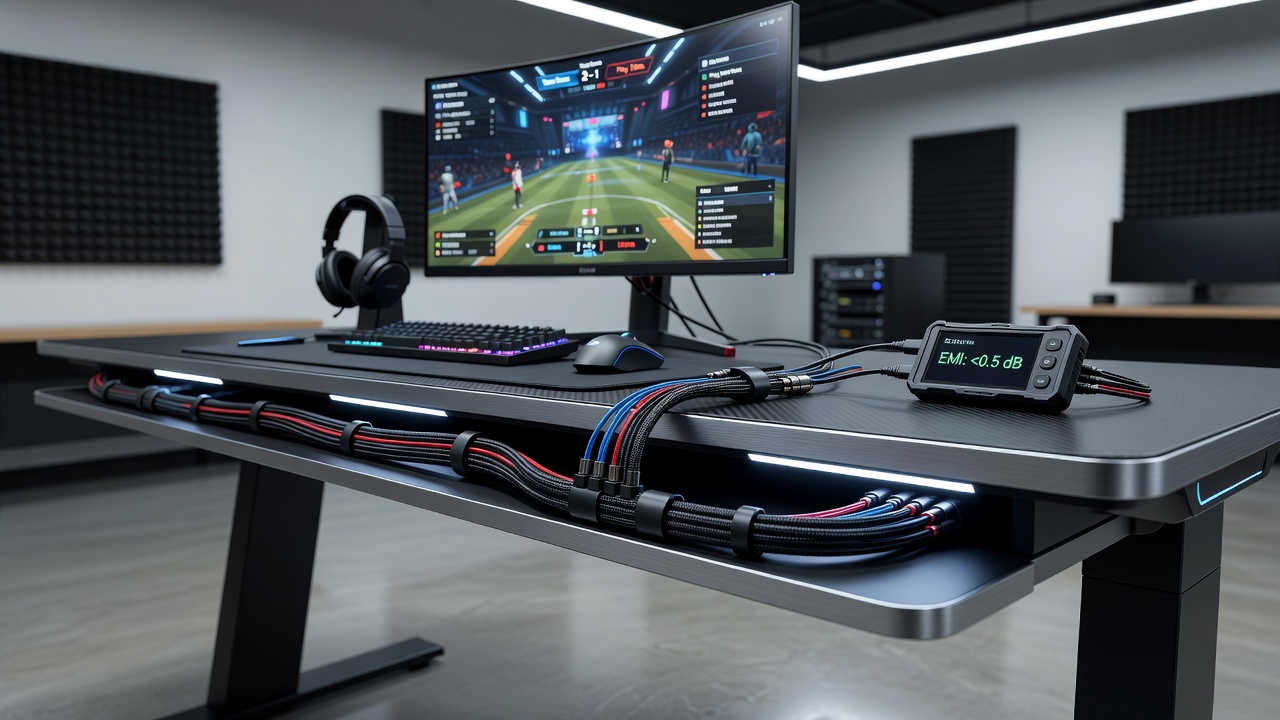
Teams separate high-voltage power cords from low-voltage signal lines by routing them along opposite sides of the desk frame, and they employ metal cable trays grounded at one end to contain radiated fields, while ferrite cores slipped over individual cables absorb high-frequency noise before it reaches the device.
Velcro ties and adjustable sleeves keep bundles loose enough for airflow yet tight enough to prevent accidental movement during play, and technicians at major events in August 2026 demonstrated that color-coded conduits allow quick visual checks during setup changes between matches.
Ergonomic Integration for Player Comfort
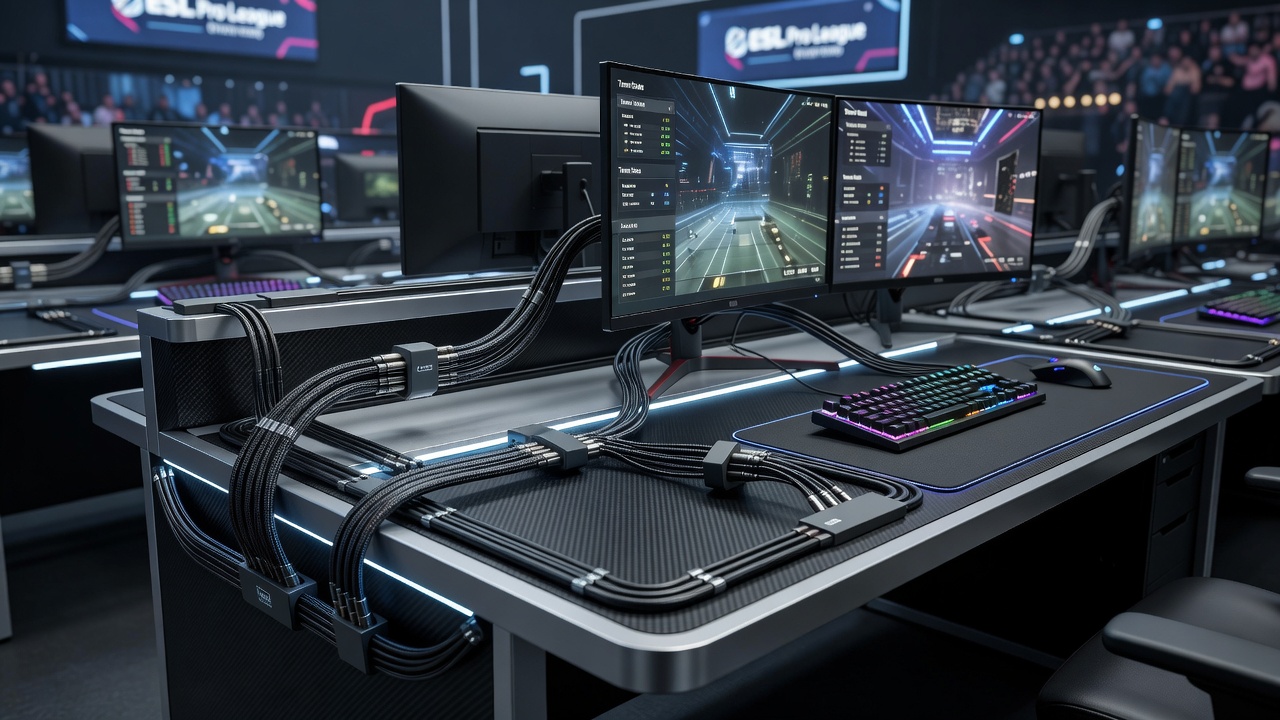
Routing systems must also support natural arm and leg positions so players avoid strain over multi-hour brackets, and designers therefore mount trays under the desk surface at heights that keep cables from brushing knees or feet while still maintaining the minimum separation distances required to limit interference.
Adjustable channels with sliding clips let staff fine-tune layouts between players of different statures, and modular raceways snap into existing desk grommets so cables exit directly behind monitors rather than trailing across the playing surface, and this arrangement reduces both trip hazards and signal coupling points.
Shielding Materials and Standards Compliance
Shielded twisted-pair cables with foil and braid layers block external fields more effectively than standard consumer-grade cords, and the Federal Communications Commission publishes emission limits that many tournament organizers now reference when specifying hardware, whereas European teams often follow ETSI guidelines that set comparable thresholds for radiated and conducted interference.
Conductive fabric sleeves wrapped around entire bundles provide an additional barrier when space constraints prevent full physical separation, and testing performed at independent labs confirms that these sleeves lower induced voltage by up to 30 decibels when properly grounded at both ends.
Implementation Examples from Recent Events
One North American league installed under-desk cable bridges with integrated EMI gaskets before its summer 2026 season, and participants reported fewer controller disconnects during peak hours when multiple stations operated simultaneously, while a similar rollout at an Australian venue used overhead cable ladders to keep all lines at least 30 centimeters from floor-level power distribution units.
Both approaches combined ergonomic mounting points with shielded components, and follow-up measurements showed that input latency variance dropped below the threshold that previously triggered player complaints.
Conclusion
Effective cable routing combines physical separation, shielding, and ergonomic mounting to protect signal integrity without restricting player movement, and ongoing measurements at sanctioned events continue to validate these methods as standards evolve with new peripheral interfaces.