Examining How Update Cadence Shapes Muscle Memory in Mobile Esports Professionals
Freya Reed · Aug 25, 2026

Examining How Update Cadence Shapes Muscle Memory in Mobile Esports Professionals
Professional mobile esports athletes face constant shifts in game mechanics because developers release patches at varying intervals, and these changes directly influence how muscle memory forms through repeated physical actions on touchscreens. Data from regional leagues tracked between 2024 and 2026 indicates that players who encounter updates every two weeks show slower consolidation of swipe and tap sequences compared with those in titles updated monthly or less often. Observers note that muscle memory relies on consistent neural pathways built during hours of drills, yet each patch can alter sensitivity curves, cooldown timers, or ability ranges and force the body to relearn motor patterns from scratch.
Defining Muscle Memory in Touch-Based Competition
Muscle memory in this setting refers to the automatic execution of precise finger movements and grip adjustments that occur without conscious thought, and studies from university labs in Canada have measured reaction consistency dropping by up to 18 percent immediately after major balance patches. Players develop these automatic responses through thousands of repetitions in practice apps and scrimmages, but frequent updates interrupt the stabilization phase where movements become fluid and reliable. Research indicates that shorter intervals between changes keep the neuromuscular system in a state of constant recalibration rather than allowing full automation.
Observed Patterns Across Major Mobile Titles
League organizers in Asia and Europe report that titles maintaining quarterly update schedules produce higher average precision scores in aim-training metrics among pros who compete in August 2026 qualifiers. In contrast, games that push weekly hotfixes correlate with increased error rates on edge swipes and combo inputs during the first 10 days after each deployment. Those patterns emerge because the brain must overwrite existing motor programs when button layouts, animation timings, or input buffers receive adjustments, and the body follows by shifting thumb placement or pressure application on the screen.
Case examples from South Korean mobile teams illustrate how athletes maintain separate practice routines for each anticipated patch cycle, using custom overlays to simulate upcoming changes before official releases arrive. Such preparation shortens the adaptation window from seven days down to three in documented instances, yet it still delays the return to peak muscle memory performance. Figures from the Mobile Esports Trade Association reveal that squads with access to private test servers retain 12 percent more of their prior movement efficiency across update windows than those without early access.
Physiological and Training Factors at Play
Neuroplasticity research shows that repeated identical movements strengthen synaptic connections in the motor cortex, while alterations in game feedback require new connections to form alongside the old ones. Professional players therefore incorporate deliberate variation drills into daily schedules to build resilience against patch-induced disruptions, and data collected during international circuits in 2025 demonstrates that athletes who rotate between multiple sensitivity profiles recover faster than those who stick to single settings. External factors such as device refresh rates and grip tape applications further modulate how quickly the hands internalize revised inputs, although core update frequency remains the dominant variable according to aggregated tournament logs.
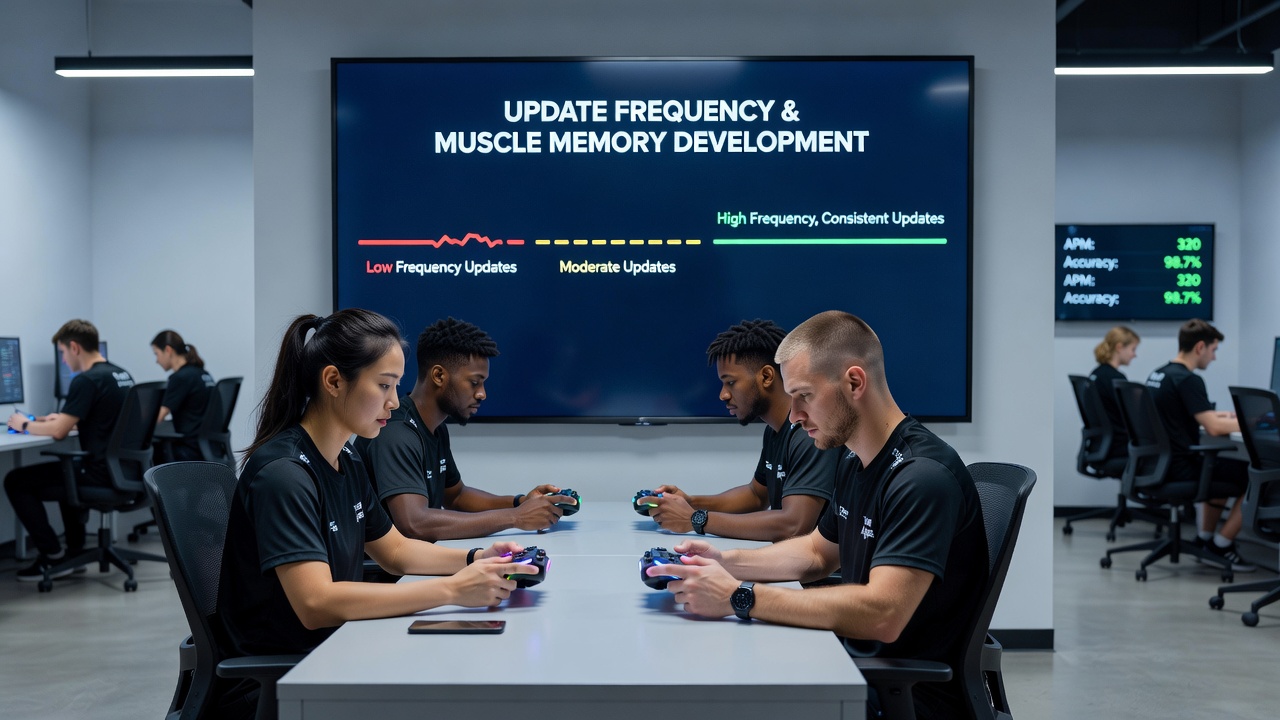
Coaches in Australian circuits have implemented progressive loading programs that gradually introduce simulated patch changes over several sessions, allowing muscle memory to evolve without complete resets. These methods draw from academic papers published by the University of Melbourne esports lab, which tracked electromyography readings in players exposed to high versus low update cadences. Results indicated steadier forearm activation patterns when changes arrived less frequently, supporting the view that stable environments permit deeper consolidation of automatic responses.
Strategic Implications for Teams and Leagues
Team managers now schedule scrimmage blocks around known patch timelines to protect ongoing muscle memory development, and several European organizations have adopted shared databases that log every input adjustment required after each update. This collaborative approach reduces redundant relearning across rosters and lets athletes focus physical practice on core movements that survive most balance shifts. Data released by the Asia-Pacific Esports Federation in mid-2026 further highlights that regions with stricter update testing requirements see fewer performance dips among their professional participants during major events.
Conclusion
Update frequency continues to exert measurable influence over muscle memory development in professional mobile esports, with evidence pointing to longer intervals between patches supporting faster stabilization of precise motor actions. Teams and researchers track these dynamics through performance metrics, physiological monitoring, and controlled training interventions that adapt to each title's release schedule. As mobile platforms evolve, the relationship between patch cadence and automatic execution remains a central factor in competitive preparation across global circuits.