Visual Feedback Systems and Their Influence on Team Coordination in Distributed Online Esports
Felix Jenkins · Aug 20, 2026
Visual Feedback Systems and Their Influence on Team Coordination in Distributed Online Esports
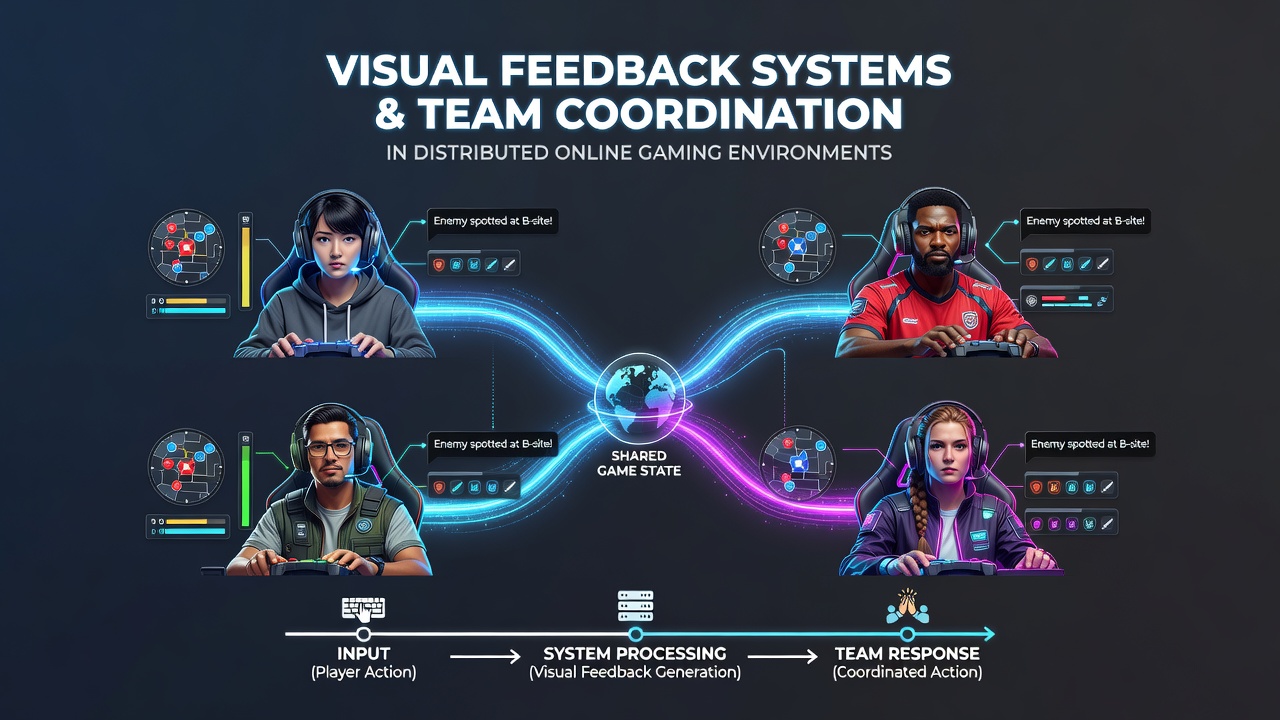
Visual feedback systems in distributed online gaming environments consist of real-time graphical overlays, status indicators, and spatial cues that transmit critical data across networked players without relying on verbal communication. These systems appear in titles ranging from competitive shooters to strategy simulations, where latency between remote participants can disrupt synchronized actions. Research from the IEEE Computer Society indicates that such interfaces reduce miscommunication rates by channeling positional and objective information through standardized visual elements like mini-maps, health bars, and directional pings.
Core Components of Visual Feedback in Multiplayer Setups
Distributed teams depend on elements such as shared vision cones, trajectory projections, and dynamic objective markers that update across client instances simultaneously. Data from global esports tournaments in 2025 shows that games incorporating synchronized visual pings achieve higher completion rates for coordinated objectives compared to those relying solely on audio channels. Observers note that these components operate through client-server architectures that prioritize low-latency rendering, ensuring that a player marking an enemy position sees the indicator reflected on teammates' screens within milliseconds.
Additional layers include color-coded threat assessments and resource timers that appear consistently across all participants. Studies conducted by researchers at the University of Toronto highlight how these standardized visuals allow squads to maintain formation awareness even when participants operate from separate geographic regions with varying network conditions.
Coordination Patterns Observed in Distributed Play
Teams using advanced visual feedback demonstrate measurable improvements in role assignment and timing execution during matches. For instance, one analysis of professional squads competing in August 2026 qualifiers revealed that visual waypoint systems enabled faster regrouping after scattered engagements, with average response times dropping by 18 percent according to aggregated tournament logs. The mechanisms function by converting complex spatial data into intuitive icons that players interpret without pausing gameplay flow.
What's notable is the way these systems handle information overload through progressive disclosure, where only relevant cues activate based on proximity or objective status. This approach prevents clutter while preserving situational awareness for all members, regardless of individual screen setups or hardware variations.
Technological Integration Across Platforms
Modern implementations draw from cloud-based rendering pipelines that maintain consistency between mobile, console, and PC clients. Industry reports from the Entertainment Software Association document how cross-platform visual synchronization has expanded since 2024, allowing mixed-device teams to share identical feedback layers during international events. Calibration routines embedded in these systems adjust for display differences, ensuring that a ping marker appears at the correct scale on both high-refresh-rate monitors and portable screens.

Integration with input devices further refines coordination, as gesture-based marking tools translate directly into on-screen indicators visible to the entire group. Data collected from regional leagues indicates that squads trained on these interfaces exhibit fewer coordination errors during high-pressure sequences, since the visuals serve as persistent reference points independent of spoken calls.
Empirical Evidence from Tournament Data
Longitudinal tracking of distributed esports events points to visual feedback as a primary factor in scaling team performance across time zones. A 2026 study released by the European Gaming Federation examined over 500 matches and found that titles with robust visual systems recorded 27 percent fewer instances of objective misallocation. These findings align with observations from Australian esports organizations, where analysts track how shared visual timelines influence decision latency in remote environments.
Patterns emerge when examining specific mechanics, such as line-of-sight indicators that update in real time. Players who rely on these cues maintain better spacing and cover usage, even when individual connections experience fluctuations. The ball's in the developers' court to refine rendering priorities that keep these elements accurate under variable bandwidth conditions.
Challenges in Scaling Visual Systems
Network variability and device heterogeneity present ongoing hurdles for consistent feedback delivery. Reports from Canadian regulatory bodies overseeing digital entertainment note that regional infrastructure differences can delay visual updates, forcing teams to develop fallback strategies. Yet developers continue iterating on predictive rendering techniques that anticipate player movements and pre-load relevant indicators to mitigate these gaps.
Observers note that accessibility considerations also factor into system design, with options for adjustable opacity and simplified icon sets appearing in recent updates. Such adaptations ensure broader participation without compromising the core coordination benefits that distributed squads have come to expect.
Conclusion
Visual feedback systems continue to evolve as foundational tools for team synchronization in distributed online gaming, supported by ongoing advancements in rendering technology and data transmission protocols. Tournament metrics and academic analyses confirm their measurable effects on coordination efficiency across diverse player bases. As global participation grows, these interfaces remain central to enabling effective collaboration regardless of physical separation.